
AN UNCOY'D STORY · GALILEO
And Yet It Moves
The line he probably never said.
Rome and Arcetri, 1616–1642
He recanted, on his knees, in front of the Inquisition.
Legend says he muttered four words under his breath as he stood back up. He almost certainly didn’t.
What actually happened is a better story than the myth.
Start here
01 / THE WARNING · Rome, 1616
He agreed to a smaller thing than the truth.
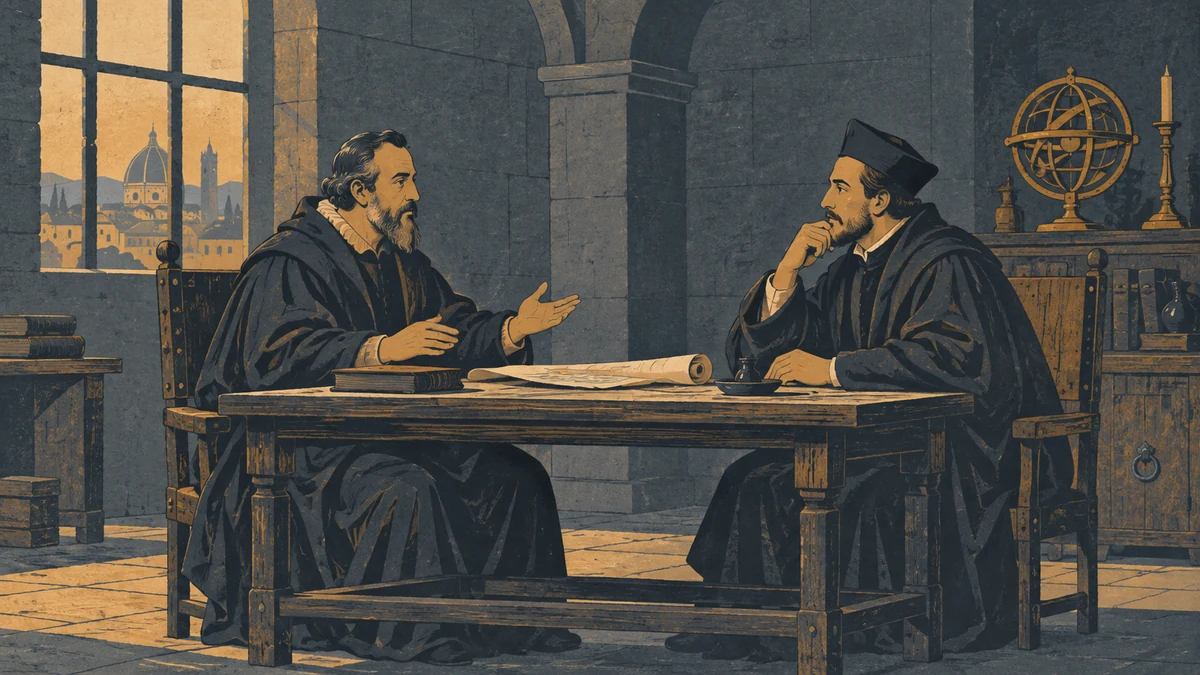
Cardinal Bellarmine, for the Inquisition, tells Galileo he may discuss the Copernican view — that the Earth orbits the Sun — as a mathematical idea, but not argue that it is physically true. Historians still debate exactly how strict the written record of that instruction was.
Galileo agrees. For years, mostly, in public, he keeps to it.
What have you quietly agreed to, while you waited for a better moment to say what you actually think?
A private reflection. Nothing is saved.
02 / THE ORDER · Rome, 1633
He recanted. The famous line came later — much later.
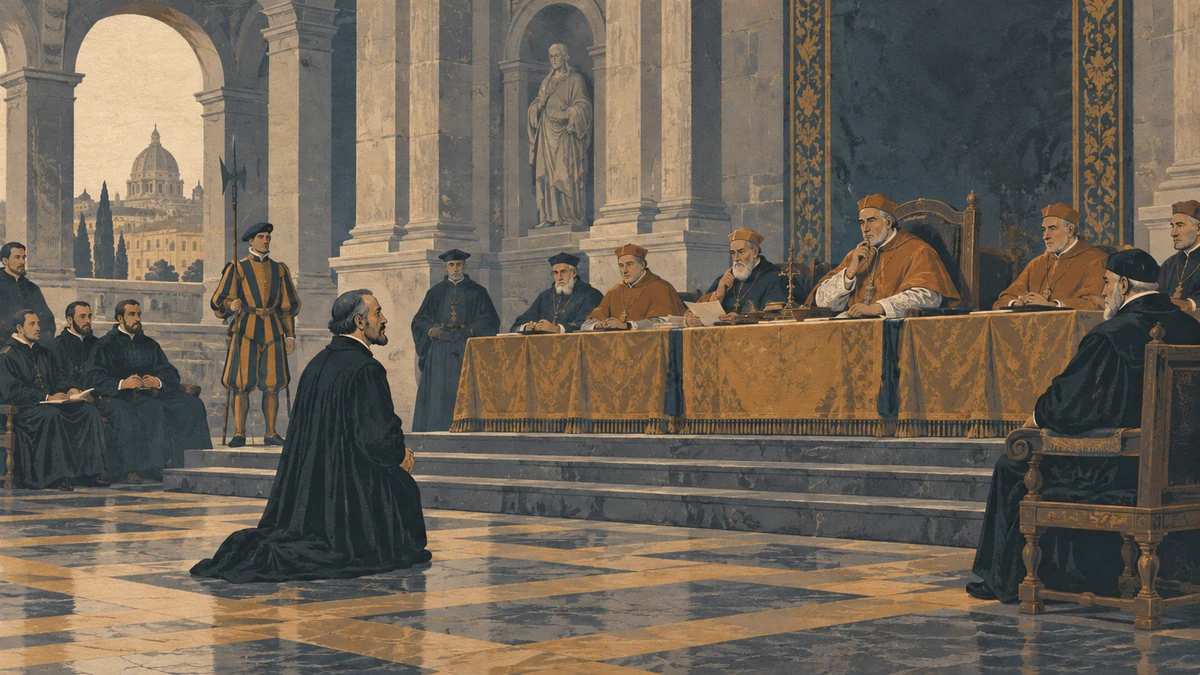
In 1632, Galileo publishes a dialogue that argues for the Copernican view anyway, putting the Pope’s own favorite argument in the mouth of a character named Simplicio — “the simple one.” Rome reads it as mockery.
He’s summoned, tried, and told to recant or face the consequences. He kneels and reads the abjuration: he does not hold the view that the Earth moves.
This is usually where the story stops — with Galileo muttering “Eppur si muove,” “and yet it moves,” in defiance as he rises. It’s one of the most quoted lines in the history of science. There is no evidence he ever said it.
The earliest known trace of the phrase appears in print in 1757, in an account by a critic living in London — 124 years after the abjuration, and 115 years after Galileo’s death. His own student, Vincenzo Viviani, wrote a biography of him in the 1650s and never mentions it. The Vatican’s own historians have said the same.
If he’d said the words silently, in his head, and meant every one of them — would that count as not yielding?
A private reflection. Nothing is saved.
03 / THE DAUGHTER · Arcetri, 1633–1642
What actually happened next.
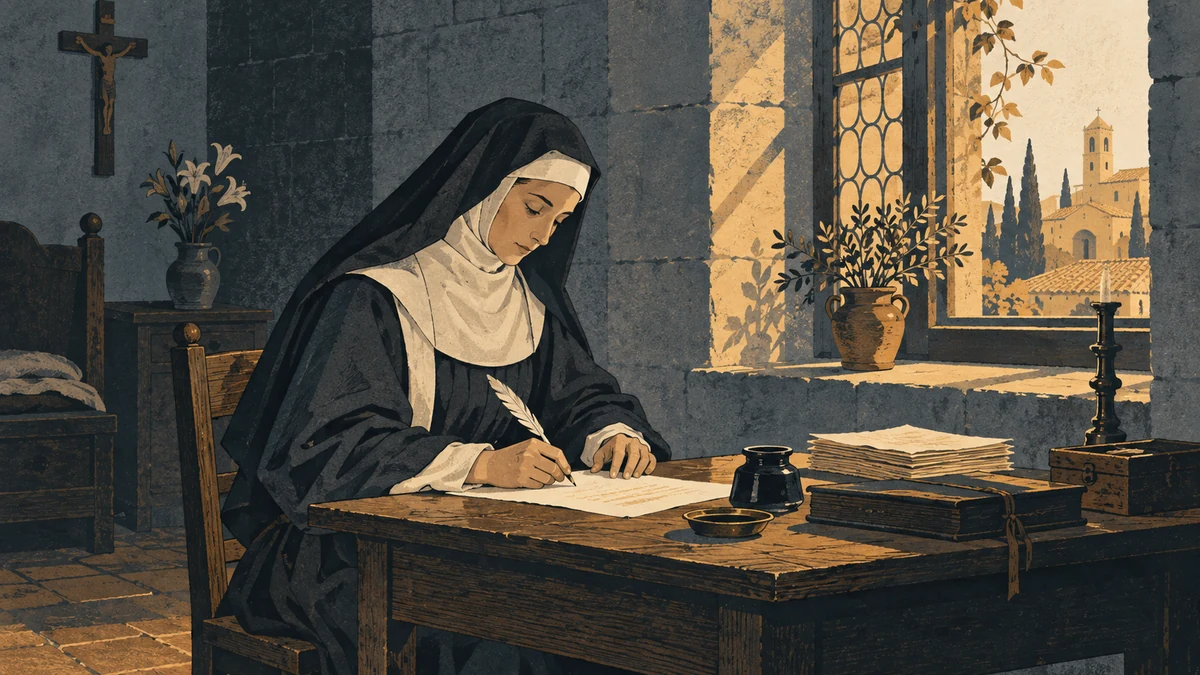
His sentence includes reciting the seven penitential psalms every week, for years. He’s old, in poor health, and confined to his house outside Florence.
His daughter, a cloistered nun named Maria Celeste, takes the psalms on herself, in his place. Over a hundred of her letters to him survive — full of food, linen, small worries, and steady devotion. His letters to her likely didn’t survive; some historians think they were destroyed to protect her, since a nun corresponding with a condemned man carried its own risk.
He never defies the Inquisition publicly again. He also finishes another book — on motion and mechanics, nothing to do with astronomy — and has it smuggled to Holland to be printed, since it couldn’t be published in Italy.
What has someone quietly carried for you that you never asked them to?
A private reflection. Nothing is saved.
WHAT HE DID
He said one thing publicly. He built another thing quietly.
What he said
- Under his own name, to the court: that he did not hold the view that the Earth moves.
What he kept doing
- Lived out his sentence, and finished a book on an entirely different subject, then had it smuggled out of the country to be printed.
The line everyone remembers (“and yet it moves”) is almost certainly invented. What he actually did — recant in public, then keep working in private, on something that would outlast the argument he’d just lost — needed no invented line to be worth remembering.
Owning your judgment doesn’t always look like a defiant last word. Sometimes it looks like what you do next.
WHERE THIS COMES FROM
Where this comes from.
The 1616 admonition and the 1633 trial and abjuration follow the Inquisition’s own case file (published as the Vatican manuscript record of Galileo’s trial) and standard modern accounts of the proceedings.
The “eppur si muove” myth: the earliest documented appearance is Giuseppe Baretti’s The Italian Library (1757) and its retelling in Querelles Littéraires (1761). Galileo’s own student and first biographer, Vincenzo Viviani, does not mention it in his 1650s account. Historians widely agree there is no contemporary record of Galileo saying it, and that it would have been extremely dangerous for him to say it in that room.
Maria Celeste’s letters and the psalm arrangement are documented in her surviving correspondence, translated and collected by Dava Sobel in Galileo’s Daughter (1999).
- Stanford Encyclopedia of Philosophy: Galileo ↗
- “And Yet It Moves” — Today in Science History, on the myth’s origin ↗
- Wikipedia: “E pur si muove,” with citation trail to primary sources ↗